Photo Albums, Frames and Gallery Walls: A Buyer's Guide
Most professional photos now live only in an online gallery. Printing them — in an album, a frame or a gallery wall — is how they actually get seen. This guide covers the choices and what quality markers matter.
This guide contains Amazon affiliate links, marked “(Amazon)”. If you buy through them, this site may earn a commission at no extra cost to you. Suggestions are based on research, not hands-on testing. Read the disclosure.
Albums: three main types
| Type | Best for | Considerations |
|---|---|---|
| Slip-in (pocket) album | Loose prints, quick family albums | Fixed print sizes; choose acid-free pockets |
| Self-adhesive or scrapbook album | Mixed sizes, notes and memorabilia | Check adhesive is acid-free and photo-safe |
| Printed photo book / flush-mount album | Weddings and professional sessions | Designed layouts; usually ordered from a lab or your photographer |
What "archival" means
For albums, mats and storage, look for materials described as acid-free and lignin-free. Acidic paper and PVC plastics yellow and damage prints over time. Terms such as "photo-safe" are less precise; product listings that mention passing the Photographic Activity Test (PAT) are more reassuring.
Wedding albums
Many wedding photographers offer albums designed from your images, often at higher quality than consumer photo books. If you design your own:
- Choose a limited number of images — often 40–80 for a single album — and tell the day as a story rather than including every shot.
- Lay-flat bindings let panoramic images cross the center without a gutter.
- Consider smaller duplicate albums for parents.
Linen or leather-bound slip-in wedding album
A good option if you have prints but don't want a designed book. Check print-size compatibility (commonly 4×6 or 5×7).
Family albums
Large-capacity slip-in album
Practical for years of 4×6 prints. Look for acid-free pages and a memo area for dates and names.
Self-adhesive scrapbook album
Better for mixed print sizes and children's artwork. Confirm the adhesive is acid-free.
Archival photo storage boxes
For prints you want to keep but not display.
Frames and mats
- Frame size vs print size. A mat makes a print feel intentional: an 8×10 print in an 11×14 frame with a mat is a common combination.
- Glazing. Standard glass is fine for most rooms; UV-filtering glazing or acrylic slows fading in bright spaces. Acrylic is lighter and safer for children's rooms.
- Mats. White or off-white mats suit most photos; choose acid-free mats.
- Style. Thin black, white or natural wood frames rarely compete with the photo.
Matted picture frames
Sets in consistent styles make mixed-size arrangements easier.
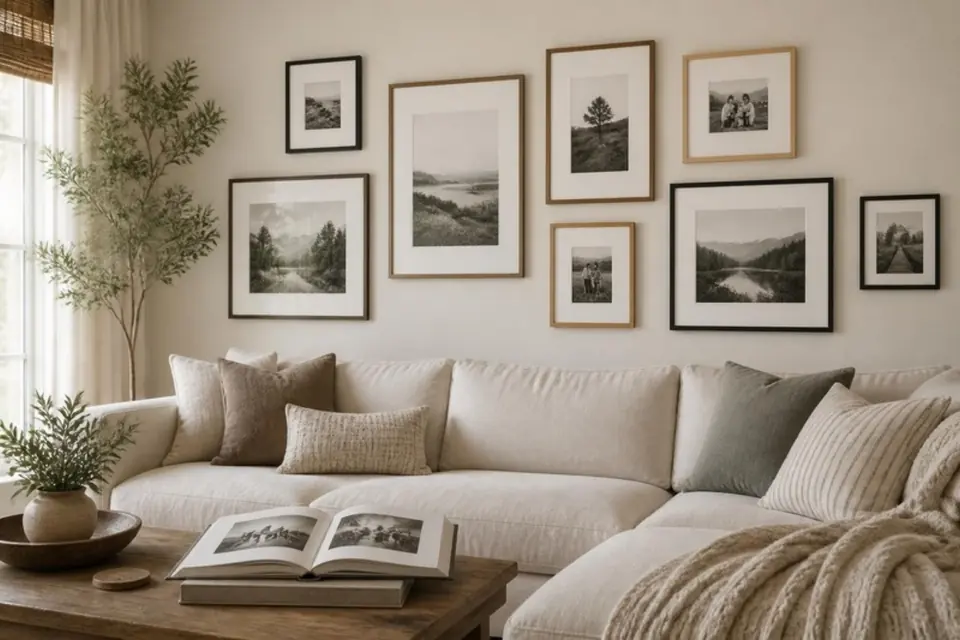
Planning a gallery wall
- Choose a unifying element — the same frame color, the same mat color, or black-and-white prints only.
- Decide the overall shape: a tight grid for a formal look, or an organic cluster for a relaxed one.
- Keep spacing consistent — 5–8 cm (2–3 inches) between frames is common.
- Template on paper first. Trace each frame on kraft paper, tape the templates to the wall and live with them for a day.
- Center the arrangement at roughly eye level — often around 145–150 cm (57–60 inches) from the floor to the center.
Gallery wall frame set
Pre-matched sets remove a lot of guesswork, and some include paper templates.
Picture-hanging kit and level
Proper hooks for your wall type, and a level, save a lot of patching.
Common mistakes
- Printing from low-resolution social media copies instead of the original files.
- Hanging prints in direct sunlight without UV-filtering glazing.
- Using non-archival albums for irreplaceable prints.
- Hanging a single small frame on a large wall — go bigger, or group several.
Planning a session and want to print the results? Start with what to wear for family photos so the colors work in your home too.